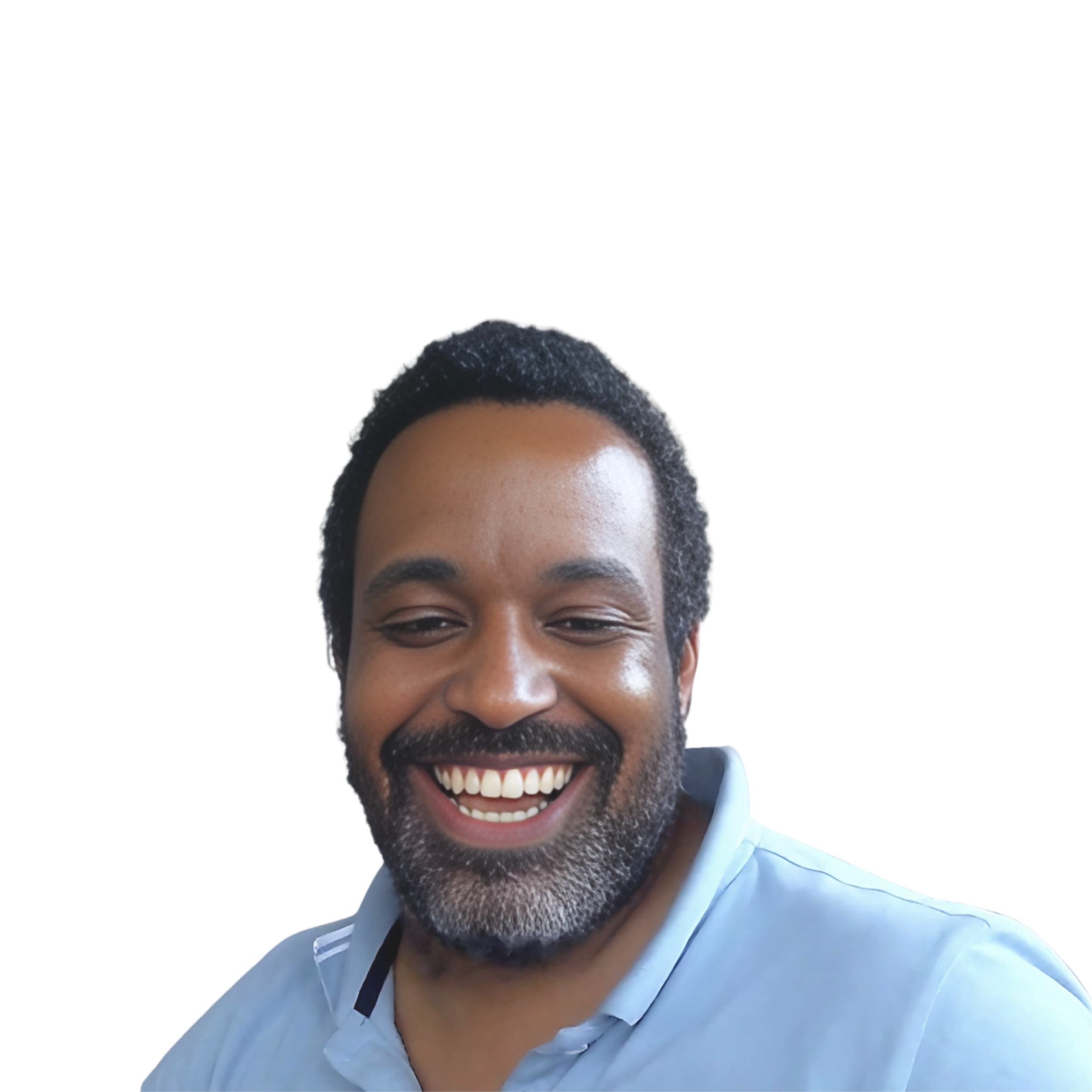
Ammanuel Santa Anna & The Luminous Synthesis

(Often Affectionately Reffered to as “The Luminous Suace”)

Who Ammanuel Santa Anna Is—And Why It Matters

Ammanuel Santa Anna is not a guru standing on a mountaintop, dispensing wisdom to those below. He is not a thought leader who has "figured it all out" and now offers a polished system from a place of completion. He is not positioning himself as someone who has transcended the struggles of growth and can now look back with detached clarity.

He is something far more valuable: someone who has lived—and continues to live—the very problem this book solves.

What makes Ammanuel's voice unique is not that he has arrived at some final destination, but that he has walked the path you may now be walking. He has felt the peculiar frustration of knowing deeply without being able to embody fully. He has experienced the disorienting gap between intellectual sophistication and lived transformation. And he has discovered something rare: a way through that honors rather than bypasses the complexity of who you already are.

The Living Paradox of Advanced Development

Ammanuel is a systems thinker, consciousness researcher, and practitioner of integral development who spent years—decades, really—accumulating insights that never quite translated into the transformation he sensed was possible. He read voraciously, consuming everything he could find on developmental psychology, contemplative traditions, neuroscience, philosophy, and the leading edges of human potential. He could articulate sophisticated models of growth with eloquence and precision. He understood the territory intellectually in ways that most people never would.

And yet, something profound was missing.

The insights remained intellectual—beautiful maps that didn't quite match the terrain of his actual lived experience. The growth felt effortful, even grinding at times, as though he were pushing against invisible resistance. And most troublingly, many personal development practices left him feeling subtly worse—more acutely aware of gaps between who he was and who he "should" be, more burdened by internal standards and ideals, more convinced that he was somehow failing at the very thing he understood so well.

As psychologist Carl Rogers once observed: "The curious paradox is that when I accept myself just as I am, then I can change." But most growth frameworks seemed designed to prevent that acceptance, constantly pointing toward what was lacking, what needed fixing, what wasn't yet adequate.

Ammanuel found himself caught in what developmental theorist Robert Kegan calls the "subject-object" problem—he could see the patterns he was caught in, but seeing them didn't automatically free him from them. In fact, the seeing sometimes intensified the entrapment, creating a hall of mirrors where awareness itself became another thing to achieve, another standard to meet.

The Birth of Something Generative

The luminous framework emerged not from a place of mastery but from a place of necessity. This is crucial to understand. This framework was not created by someone who had transcended struggle and was now offering a system from on high. It was forged by someone in the midst of the developmental crucible, someone who needed a lifeline that the existing models simply weren't providing.

Ammanuel needed a way to bridge the gap between what he understood intellectually and who he was becoming experientially. He needed a practice that would:

  • Honor his complexity without overwhelming him with it

  • Respect his capacity without shaming him for his current limitations

  • Treat him as fundamentally whole while still inviting expansion

  • Work with his natural rhythms and patterns rather than against them

  • Generate hope and possibility rather than awareness of deficiency

What emerged was a framework rooted in what organizational psychologists call Appreciative Inquiry—a methodology that begins not with problems to be solved but with life-giving forces to be amplified. As pioneered by David Cooperrider, Appreciative Inquiry operates on a radical premise: that human systems grow in the direction of what they persistently ask questions about.

If we constantly ask "What's wrong? What needs fixing? Where am I falling short?" we generate a system organized around deficit and repair. But if we ask "What's already working? What gives life here? What wants to emerge?" we generate a system organized around possibility and generativity.

This is not positive thinking or spiritual bypassing. It is sophisticated developmental science applied with precision and care. It is recognizing that you are not a problem to be solved but a mystery to be unraveled—a living system with inherent wisdom, natural developmental intelligence, and a trajectory toward wholeness that is already underway.

A Framework Born from Lived Experience

What Ammanuel created was not just for himself, though it began there. It was for anyone who has ever felt that their intellectual and spiritual development has outpaced their capacity to live what they know. For anyone who has sensed that the next edge of growth is not about accumulating more information, mastering more techniques, or achieving more milestones—but about becoming more of who you actually are.

As the poet Rainer Maria Rilke wrote: "Perhaps all the dragons in our lives are princesses who are only waiting to see us act, just once, with beauty and courage. Perhaps everything that frightens us is, in its deepest essence, something helpless that wants our love."

This is the spirit of the luminous framework. It treats your struggles not as enemies to be vanquished but as allies carrying important information. It sees your sensitivity not as fragility but as a sophisticated capacity for discernment. It recognizes your overwhelm not as weakness but as evidence that you're processing complexity beyond what most people even perceive.

Ammanuel writes from within the process, not from beyond it. He is not offering this framework because he has transcended the need for it. He is offering it because it continues to serve him, day after day, practice after practice—and because he has witnessed, again and again, how it serves others at similar levels of development.

This is the gift of a guide who walks beside you rather than ahead of you—someone who knows the terrain intimately because they're navigating it themselves, someone whose credibility comes not from having "made it" but from having discovered tools that actually work in the midst of the journey.

The Depth Behind the Framework

Ammanuel's background includes deep, sustained study of some of the most sophisticated models of human development available:

  • Integral Theory and Spiral Dynamics (Turquoise consciousness and beyond)—understanding the complex, holistic stages of consciousness that integrate multiple perspectives and hold paradox without collapsing it

  • Dabrowski's Theory of Positive Disintegration (Level V multilevel development)—recognizing that psychological crisis and breakdown can be necessary precursors to breakthrough, and that heightened sensitivity and intensity are often markers of advanced developmental potential

  • Constructive-developmental psychology (Robert Kegan's orders of consciousness)—grasping how our very structure of meaning-making evolves, changing not just what we think but how we think

  • Contemplative neuroscience and embodied cognition—understanding that transformation happens not just in the mind but through the living, sensing, feeling body as an instrument of knowing

  • Appreciative Inquiry and strengths-based development—working from what's life-giving rather than what's broken, amplifying existing capacities rather than imposing external standards

  • Trauma-informed practice and polyvagal theory—recognizing that nervous system regulation and felt safety are prerequisites for sustainable growth, and that pushing through resistance often creates more resistance

  • A lifetime of exploring non-dual consciousness—direct experiential knowing of the ground of being that precedes and includes all developmental structures

But here's what matters more than any credential or studied framework: Ammanuel brings lived experience of the territory this book maps. He knows what it is like to feel simultaneously overstimulated by the complexity you perceive and underwhelmed by the simplistic solutions offered by most personal development approaches. He knows the hunger for depth that doesn't become density, for structure that doesn't rigidify into dogma, for guidance that doesn't condescend or flatten your actual experience.

As coaching pioneer Sir John Whitmore observed: "The opponent within one's own head is more daunting than the one on the other side of the net." Most growth frameworks inadvertently strengthen that inner opponent—the voice that judges, critiques, and finds you wanting. The luminous framework does something radically different: it befriends that voice, honors its protective function, and gently invites it into a larger story.

The Invitation This Book Extends

This book is Ammanuel's gift to you: a practice that meets you exactly where you are and invites you into where you are becoming. Not through force or willpower. Not through standards and shoulds. But through recognition, curiosity, and the profound respect of being seen as the complex, capable, evolving being you actually are.

Throughout these pages, you'll find not just theory but living practice—tools you can use immediately, frameworks that illuminate rather than obscure, and a relentless commitment to your inherent wholeness even in the midst of your becoming.

You'll encounter quotes and wisdom from researchers, poets, and practitioners who have understood what you're experiencing. You'll find tips and techniques embedded in a larger narrative of hope. And most importantly, whenever something challenging or complex is introduced, you'll be given digestive space—room to metabolize the insight through appreciative, generative questions that help you make it your own.

As organizational consultant Margaret Wheatley reminds us: "There is no power for change greater than a community discovering what it cares about." This book invites you into community—with yourself first, and then with others who are walking similar paths. It invites you to discover what you care about beneath all the conditioning and comparison. It invites you to recognize that you are not behind, you are not broken, and the very things you thought were obstacles may be your greatest assets.

Welcome to a framework that sees you not as a project to be completed but as a miracle in motion—a living system unfolding according to its own deep intelligence, worthy of wonder, capable of transformation, and already, always, inherently luminous.

Schedule a Chat